

Shopify: Growth without limits
E-commerce has changed rapidly, and Shopify is the answer for brands looking to grow fast. As a SaaS platform, Shopify combines unlimited scalability with user-friendly operation. Unlike complex self-hosted solutions, Shopify takes care of infrastructure, security, and updates—allowing you to focus on your business. This makes Shopify ideal for D2C brands that want to quickly expand into new markets or grow their product portfolio. Technically, Shopify is designed for flexibility. The Liquid template engine enables custom theme programming, the Admin API offers complete control over data, and the app marketplace connects with hundreds of integrations, from ERP and marketing to fulfillment. For businesses with high traffic demands, Shopify Plus offers an enterprise solution with dedicated infrastructure and custom development capabilities. A major advantage of Shopify is its built-in conversion optimization. With A/B testing tools, fast checkout processes, and mobile-first architectures, Shopify is inherently designed for high conversion rates. Furthermore, Shopify handles PCI and GDPR compliance – critical aspects that must be implemented manually with self-hosted systems. At the same time, true optimization of Shopify requires more than a standard setup. The right theme architecture, intelligent app combinations, seamless ERP integration, and well-designed automations are what distinguish a good Shopify store from a great one. This is precisely where the expertise of an experienced partner comes into play.

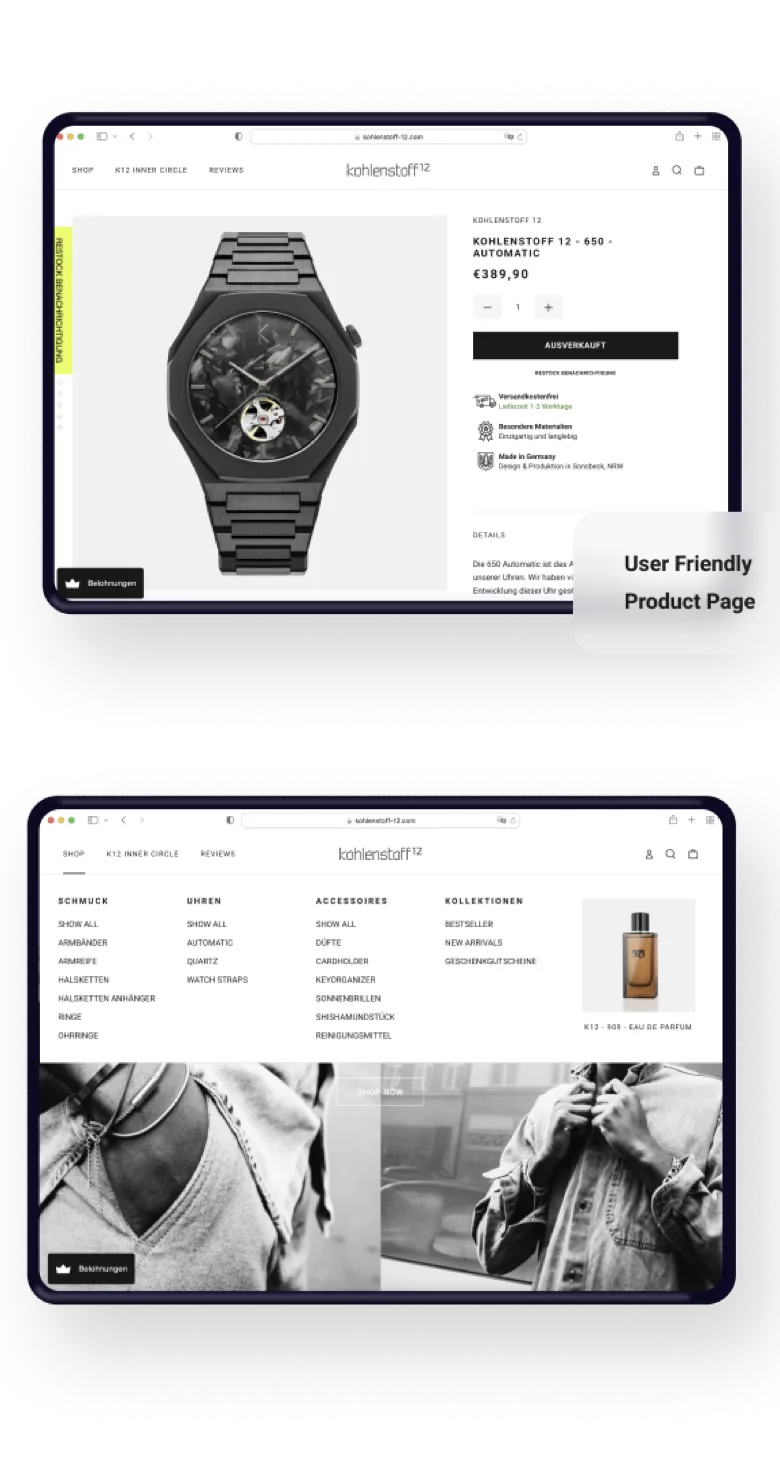
We offer comprehensive services to meet all Shopify-specific requirements and future-proof your shop.


We develop custom Liquid themes from scratch or optimize existing themes for maximum performance. We strictly adhere to Core Web Vitals, ensuring clean code structure and maintainability. The theme is tailored to your brand, optimized for conversions, and developed with a mobile-first approach. Theme updates and feature extensions are then easily implemented.
Shopify offers hundreds of apps, but the right combination is crucial. We select clean, proven apps, integrate them consistently, and develop custom apps when needed. Using REST and GraphQL APIs, we build bidirectional data flows for a professional overview.
Marketplace integration for Amazon, eBay, etc., to expand your sales channels with Shopify as the central control system. ERP integration automates inventory synchronization and order flow.
Technical marketing begins with GDPR-compliant server-side tracking and ends with an optimized data layer. API interfaces seamlessly connect Shopify with all marketing tools.
Standard workflows are often insufficient. We develop customized automations: customer group management based on purchase history, automatic discount triggers, order routing to various fulfillment providers, and notification logic for returns. Using specialized Shopify workflows, webhooks, and custom apps, we implement solutions that make your business scalable.
We conduct a comprehensive discovery process. Together, we clarify your business goals, your current ecosystem (ERP, CRM, marketing), and define the optimal Shopify configuration.
Based on this, we design the theme architecture and API strategy. We document which custom developments are needed, how integrations are structured, and which apps are used.
The theme is being developed in parallel. We're programming in Liquid using modern best practices – responsive, high-performing, maintainable, and conversion-optimized.
This is where the “integration” happens. We connect Shopify with ERP, CRM, and marketing systems. Automated data flows are created via webhooks, REST API, and GraphQL – all tested and documented.
Before your store goes live, it undergoes rigorous testing. Performance audits, functional tests, browser compatibility, and ERP integration are systematically validated.
The critical moment. We launch your store with a detailed go-live plan. During the launch phase, we are available for rapid problem resolution and performance optimization.


Shopify is particularly well-suited for D2C brands, traditional online retailers, and brands looking to quickly expand internationally. The platform scales from small startup projects to enterprise setups with Shopify Plus, covering both B2C and basic B2B scenarios.
Shopify is a hosted SaaS platform with extremely fast onboarding, an app ecosystem, and a globally scalable infrastructure, while Shopware 6, as an open-source solution, offers maximum control over hosting, code, and custom extensions. Which platform is the better fit depends on requirements such as internationalization, the degree of customization, IT resources, and legal regulations.
Yes, existing shops can generally be migrated to Shopify. Products, categories, customers, orders, and content are transferred in a structured manner, while we plan redirects and URL structures to maintain SEO visibility and ongoing campaigns.
Liquid templates, custom apps, and the Shopify APIs allow for the implementation of individual features such as custom checkout logic, product configurators, B2B functions, or special shipping rules. For highly complex requirements, Shopify can be combined with a custom frontend as a headless backend.
Since Shopify handles hosting, updates, and basic security, the technical maintenance effort is significantly reduced. The focus during day-to-day operations is primarily on conversion optimization, content management, marketing automation, and the further development of custom features and integrations.