
Autonomous. Transparent. GDPR-compliant.
Agentic AI Layer for SuiteCRM

Your data stays in Germany or the EU

Running on your own hardware if you wish

AI runs decoupled from the CRM core
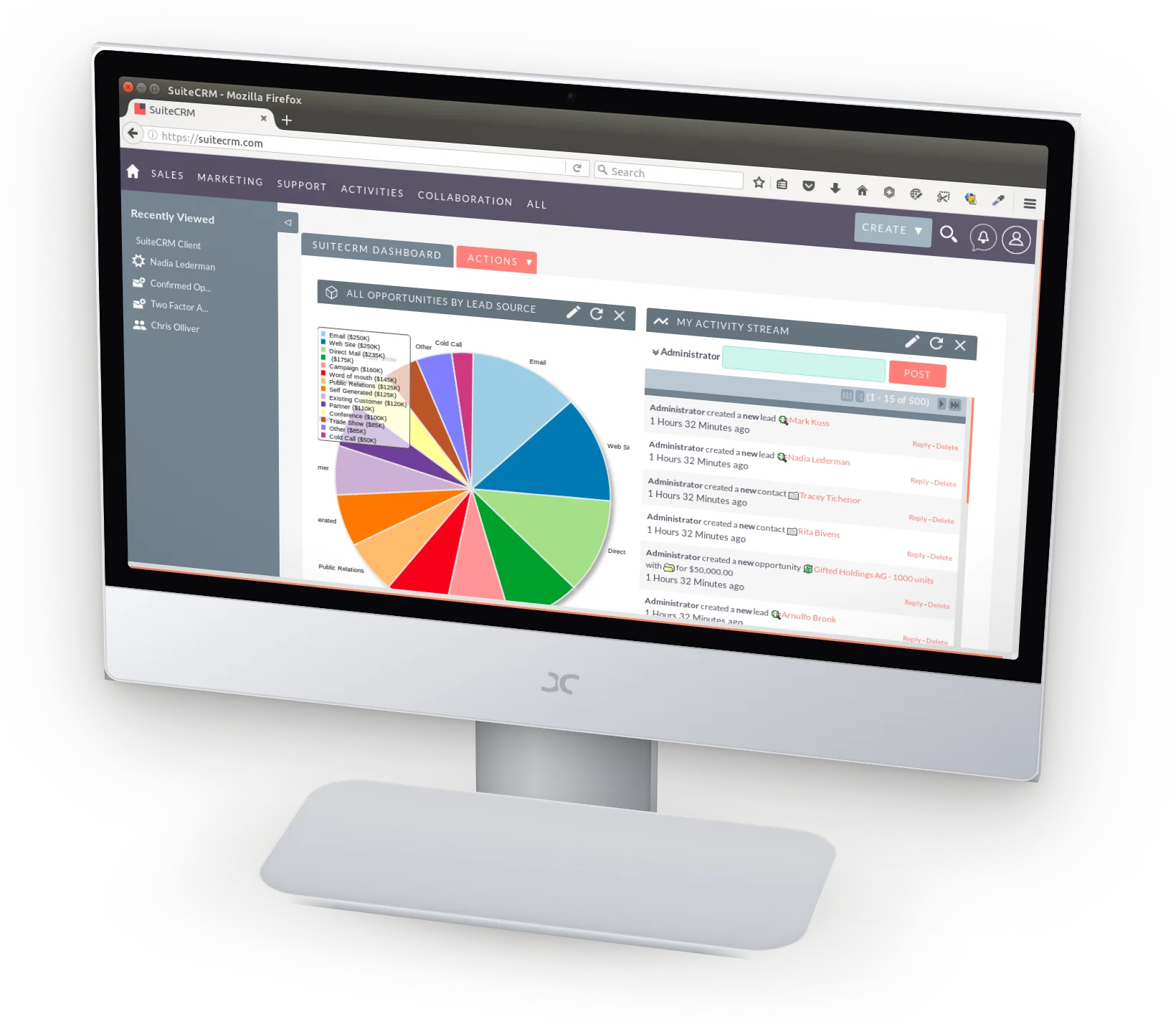
An AI agent pursues a goal. It breaks that goal into steps, gathers the information it needs, decides and carries out actions directly in the system.
An agentic AI layer brings this capability into SuiteCRM and works event-driven. A new lead appears, the agent researches it, scores it, writes a briefing into the record, creates a task and logs its reasoning. Your team steps in where its decision is needed.
There is no protected definition of "agentic AI". These three capabilities help you assess solutions with confidence:
Not every process needs these capabilities. Where a fixed sequence is enough, we recommend classic automation. It is quicker to implement and more economical.
Four use cases where agents work directly inside the CRM: in sales, in service and in the processes that follow.

One click on "research lead" and the agent scans company news, competitors and public signals, then writes a structured briefing back into the CRM: stakeholders, likely objections, talking points. Preparation time drops from 20 to 40 minutes to seconds.

The agent finds contacts in SuiteCRM without recent activity, scores their likelihood to respond and drafts personalised messages that refer to earlier touchpoints. Revenue from the data you already hold.

A new case arrives by email or through the portal: classify it, search the knowledge base and past cases, resolve routine requests directly, pass on the rest with a briefing and a proposed solution. Specialists focus on demanding cases.

"Closed won" creates the order in the ERP; stock levels and lead times flow back into product data and customer records. One shared set of data across all systems.
The AI runs outside the PHP core. Your users' interface stays fast even when a language model takes longer, and SuiteCRM updates run independently of the agent.
SuiteCRM (logic hooks, process API) sends a webhook to the middleware. Orchestration, guardrails, masking of personal data and the queue all live there. From there it goes to the language model and the connected tools, and the result flows back into the CRM through the REST API. The technical side of that connection is covered on the page for SuiteCRM development and integration.
Logic hooks as an asynchronous webhook on save, the SuiteCRM process API for a button such as "research lead" right in the interface, and scheduled runs for bulk work, queued to match the API rate limits.
Tools are connected through the Model Context Protocol, the open standard that established itself across 2025 and 2026 as the common interface between language models and business systems. The practical benefit for you: tools and models can be swapped without rebuilding the integration. You stay flexible in your choice.
00%
lower cost per standard service request than with manual handling
000%
return on average: 3.50 dollars for every dollar spent on AI service
00%
of dormant contacts reactivated (5 to 15 per cent), 2 to 5 per cent of them to a meeting or deal
These figures are 2026 industry benchmarks. Your own calculation is produced during the discovery sprint from your process metrics.
Service example. Six to eight tickets per hour per employee works out at 2.50 to 4.00 dollars per ticket fully loaded. An agent operates at roughly 0.50 dollars per interaction, in parallel and without waiting time.
Reactivation example. One thousand dormant contacts, 5 per cent reactivation and a customer value of 300 dollars come to roughly 15,000 dollars in additional revenue from data you already hold.
An agent works in loops: it calls tools, checks interim results and passes the accumulated context to the model at every step. A single user task can involve ten to fifteen model calls.
That is why we build cost control into the architecture from the start:
We therefore calculate with a transparent cost per completed task.
Four factors decide whether an AI agent delivers in daily work. We build them into every project from the start.

We start with a process that has high volume and recurring, rule-based decisions, together with a calculation that shows the benefit.

An agent is as good as the data it works with. That is why the data audit comes first: we resolve duplicates, gaps and field maintenance before launch.

Loop limits and token budgets are built into the code. Every invoice stays predictable.

Together we define what the agent decides on its own and where a person approves. Governance is part of the blueprint from day one.
1 · Discovery sprint and data audit, one to two weeks. Identify the processes with the highest automation value, audit data quality for gaps, duplicates and schema drift, deliver a roadmap with an ROI calculation. Outcome: a well-founded basis for your decision.
2 · Prototype and validation, two to three weeks. One selected use case built for real: API user, OAuth keys, middleware workflow, model selection, prompt calibration on anonymised production data. Outcome: a running agent on your data.
3 · Production deployment, four to eight weeks. Asynchronous queues matched to rate limits, fallback models for high availability, guardrails, approval points, token monitoring, observability, team training. Plus a test suite that checks the agent against a fixed set of real cases before every update. Outcome: a system in operation, with a measurable hit rate.
4 · Managed AI operations, ongoing. Watch latency and cost, refine prompts from user feedback, update models, keep the integration stable across SuiteCRM updates. Outcome: an agent that still works reliably twelve months from now.
Ongoing care keeps the agent on course: models evolve, interfaces change and data structures grow. We make sure your agent grows with them.
Each module can be commissioned on its own. Model costs run through your own provider account: you pay them directly and see every line.
One to two weeks
After the sprint you decide freely on the next step. The analysis is yours to keep.
Two to three weeks
One selected use case, built for real on your data. A running agent your team can test right away.
Ongoing support
We watch latency and cost and set the limits for model costs in the architecture.
In a non-binding initial call we clarify your use case and recommend the right way to start.
Data protection and control are the basis for every approval. So this section describes in concrete terms what we implement technically.
Article 22 of the GDPR governs decisions based solely on automated processing that significantly affect the person concerned. In its Schufa ruling at the end of 2023, the European Court of Justice made clear that a decisive score can already constitute such a decision.
For your CRM that means an agent prepares, scores and justifies a case. A person decides on a cancellation, a rejection, a creditworthiness rating or an individual price.
We implement that technically as an approval point in the workflow. The agent pauses its state, presents the prepared decision with its reasoning, and continues as soon as an authorised person approves. The result is legally sound decision support.
From 2 August 2026 the EU AI Act requires that people can tell when they are interacting with an AI, and that AI-generated content is labelled. For service agents in customer contact we build that notice directly into the interface, visible at the moment of interaction.
An agent's risk class depends on its purpose. If it takes on a new task, such as evaluating applicants or staff performance, the classification can change. We therefore document the approved use cases and agree any new purpose with you.
Every agent gets its own API user with exactly the rights its use case needs. A service agent reads cases and the knowledge base and writes into the case. Further rights are granted specifically when a task requires them.
On top of that, guardrails check inputs and outgoing actions before they reach the CRM. Among other things they detect instructions that may be embedded in emails or web pages. Instructions and processed content are strictly separated in our architecture, and critical actions always pass a review.
SuiteCRM runs in your environment, in Germany or the EU. For the language models you can choose between European providers and models running locally on your own hardware. Personal fields are masked before the model call wherever the use case allows. Every agent run is logged: trigger, data basis, tool calls, result. That way it is always clear how a result came about.
With the current version as well as the 7 series. The layer works through logic hooks and the REST API, which are available in both lines. Buttons in the interface are implemented to match your version.
The task moves to the queue and is retried; if the disruption lasts longer, a second model takes over. The CRM keeps running independently because the AI works outside it. Your team carries on without interruption; the briefing simply arrives a little later.
Yes, once you approve it. To start with, we recommend a draft in the record that a person reviews and sends. With a proven hit rate this can be extended step by step for clearly bounded cases.
Discovery and prototype together take three to five weeks, production a further four to eight. The biggest influence on the timeline is the state of your data.
The retainer for operations, plus model costs through your own provider account. Both are capped, and we set the limits together.
Yes, that is exactly how we recommend getting started: one process, built for real, measured, then decided on.
In the discovery sprint we look at your processes and your data and run the numbers on one use case. You get a roadmap with effort, expected return and a clear recommendation for the next step.
Let’s Make Things Happen

 hello@codecouncil.de
 Tel +49 6151 50 19172