




Operations and marketing
Interfaces & Integration: The backbone of your system landscape
In modern e-commerce, nothing operates in isolation. Your online store needs to communicate with your ERP system (to synchronize inventory), your CRM system needs to receive customer data from the store (for targeted campaigns), and all systems need to communicate with marketplaces, payment providers, and shipping companies. APIs are the nervous system of this communication. However, many companies underestimate the complexity. A faulty API call can result in lost orders, slow data synchronization leads to overselling, and a poorly documented interface becomes technical debt that can haunt you for years. APIs are the invisible foundation of your scalability. They separate the front end and back end, allow different teams to work independently, and create the flexibility for future changes. A well-designed API architecture is the difference between a store that grows with you and one that becomes a hindrance. We follow the API-first philosophy: Before we write the first line of code, we define the interfaces. This ensures that systems are modular, testable, and future-proof from the outset - instead of having to patch up the code later. The two dominant API standards in modern e-commerce are REST and GraphQL. REST (Representational State Transfer) is the older, established standard: The server defines fixed endpoints, and the client calls these endpoints. GraphQL is the more modern approach: The client defines exactly which data it needs, without sub-questions or overrides. This is particularly valuable for headless frontends, mobile apps, and resource-critical environments. In addition, there's batch processing: Large amounts of data (e.g., 50,000 new products in your inventory system) cannot be transferred "live"—this would overload the API and the server. We implement batch jobs that run in chunks at night and reliably synchronize data without impacting live operations.

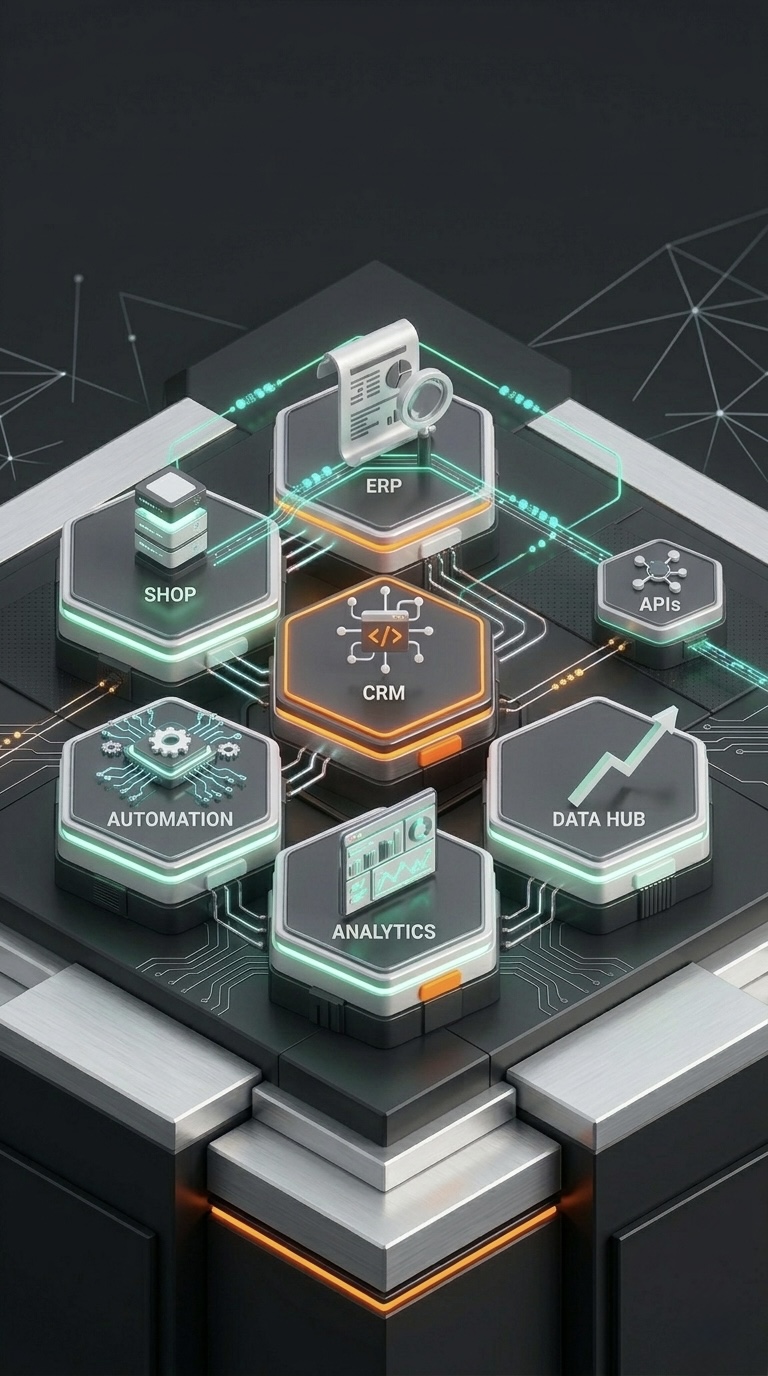
We design and build custom APIs specifically tailored to your requirements. We adhere to OpenAPI/Swagger standards to ensure the API is self-documenting and maintainable. Together, we decide: REST, GraphQL, or a hybrid approach? Which versioning strategy? Which rate limits to protect against abuse? The result: An API that not only works today but will still be maintainable in five years.
The core element: your online store and inventory management system must be perfectly synchronized. We build bidirectional connections (Shopware 6, Shopify, WooCommerce, JTL, etc.) to your ERP system. Inventory flows from the ERP to the online store, new orders from the online store to the ERP, and invoices and delivery notes are sent back. All in real time or batch processing – depending on your requirements.
Customer data is gold. We synchronize contacts from the shop to the CRM, trigger automated email campaigns based on purchasing behavior, and enrich customer data with browsing history. This transforms anonymous visitors into real contacts who can be targeted effectively.
We integrate payment processors (Stripe, PayPal, Klarna, etc.) and shipping providers (DHL, UPS, DPD, etc.). This means: Reduced manual stable hosting infrastructure guarantees API performance.
Amazon, Zalando, About You, TikTok Shop – each marketplace has its own API. We orchestrate these centrally via your shop or an integration hub, allowing you to manage products, prices, and inventory centrally without having to manage each platform individually.
An integration is only as reliable as its worst downtime. We implement robust error handling (what happens if a partner's API is temporarily unavailable?), fallback mechanisms, and automated notifications. We monitor all interfaces 24/7 for anomalies.
We begin with a detailed system landscape analysis. Which systems are currently communicating with each other? Where are there data leaks or sources of manual error? What new integrations are planned?
We design the interface architecture: Which data flows in which direction? Synchronous or asynchronous? We create an OpenAPI specification document that all stakeholders understand.
Clean, production-ready code. We use modern frameworks (Node.js, Python, etc.), and implement authentication, logging, testing, and documentation from day one.
We test not only the API itself, but also end-to-end scenarios: “What happens when an order with 10 items arrives on Amazon?” We simulate error scenarios and ensure that everything is robust.
After go-live, we monitor all interfaces. We send alerts in case of problems, conduct weekly performance reviews, and continuously optimize.
We develop online shops that work with inventory management, CRM and marketplaces, and we support them over many years. If you build a shop with us, you work with the same team in concept, development and operations.
Aziz Ajaghfouf, Managing Director

APIs (Application Programming Interfaces) are the digital bridges that allow different systems to communicate with each other automatically. In e-commerce, they are indispensable for breaking down silos: They ensure that inventory, customer data, and payments flow between the shop, ERP, and logistics in real time without manual intervention. Marketplace integrations expand the interface landscape.
REST is the proven industry standard for server-to-server communication: It is robust, easy to implement, and universally compatible. GraphQL, on the other hand, is ideal for modern (headless) frontends: It allows the client to query only the data it needs. This prevents unnecessary data transfer (“over-fetching”) and makes mobile applications significantly faster.
We rely on “delta updates”: Instead of completely re-transmitting huge datasets, we only send the changes (e.g., updated inventory levels). We also use asynchronous message queues. This means that even if a system is briefly offline, no data is lost; instead, it is buffered and processed as soon as the connection is restored.
Scalability begins with the architecture. We rely on a modular “API-first” approach and cloud resources that grow elastically. Through mechanisms like rate limiting and caching, we ensure that your interfaces remain stable even during traffic peaks (e.g., Black Friday) and that the ERP system doesn't collapse under the load of the online shop.
Yes, absolutely. An interface is only as good as its monitoring. We offer 24/7 monitoring for all data flows. In case of anomalies or errors, you receive automatic alerts and can often intervene proactively to ensure the long-term stability of your business operations.