




Operations and marketing
ERP & WMS Integration for E‑Commerce
ERP and inventory management systems form the backbone of successful e-commerce solutions. They are far more than mere administrative tools – they control, connect, and automate all business processes of a digital retailer. From product management and shipping to payment processing, analysis, and controlling: a well-designed ERP e-commerce integration determines efficiency, customer satisfaction, and growth.
A modern ERP system plans and manages all company resources. This includes inventory management, invoice automation, shipping management, and finance, as well as CRM integration and controlling. Inventory management systems focus on warehouse management, order processing, multi-warehouse coordination, and returns management. Together, they create the foundation for a seamless connection between the online shop, back office, and logistics processes. ERP integration in e-commerce fully automates data flows. Orders from the shop are automatically transferred to the ERP system, inventory levels are updated in real time, and invoices and delivery notes are generated automatically. This bidirectional synchronization reduces error rates, shortens processing times, and ensures a clear overview of all transactions.The central inventory management system integrated into your online shop prevents overselling, as stock levels are synchronized across all sales channels in real time. This enables efficient warehouse planning with automatic reordering when minimum stock levels are reached and forms the basis for intelligent supply chain optimization. The integration also offers automated shipping workflows, including label printing, tracking updates, and returns management – all fully integrated into your e-commerce platform. Multichannel management is a key component of modern systems. Today, retailers sell not only through their own online shop but also on marketplaces like Amazon, About You, Zalando, and Otto, as well as via social media channels. Central coordination of these channels via an ERP system enables real-time inventory reconciliation, consistent pricing strategies, and transparent order processing. This ensures high delivery performance and customer satisfaction while simultaneously reducing warehousing costs.
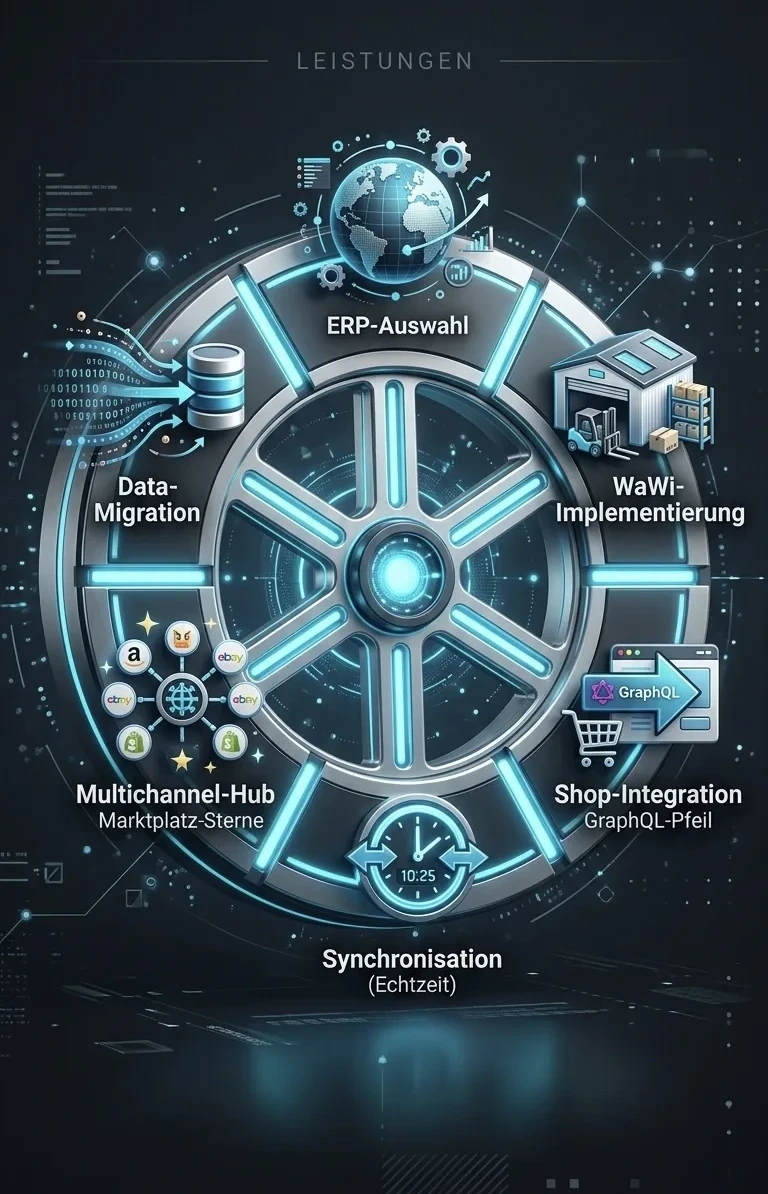
Analysis of your business processes and recommendation of the appropriate system - tailored to company size, industry, budget and growth targets.
Tailor-made ERP solutions for retailers - from simple warehouse management to multi-warehouse systems with batch tracking and serial number management.
Shop integration with your existing ERP system for bidirectional synchronization of orders, inventory, customer data, and invoice information. We support REST APIs, GraphQL, and custom interfaces.
Real-time reconciliation of all processes - from order receipt to invoicing to shipping processing, including automatic label printing and tracking updates.
Central management of all sales channels (Amazon, AboutYou, Zalando, Otto, other marketplaces) from a single ERP system - for maximum efficiency and inventory control.
Secure data transfer and development of individual business processes according to your specific requirements.
We don't start with technology, but with understanding. Audits, process analysis, and clear goals form the basis.
Several solutions are being considered. We will decide which approach best suits your company.
The final system design becomes the perfect template for our integration developers - no misunderstandings, maximum efficiency.
The design transforms into a high-performance, secure ERP system. An integration that truly works and scales.
All services from a single source - from strategy to go-live, without external interface problems.
We develop online shops that work with inventory management, CRM and marketplaces, and we support them over many years. If you build a shop with us, you work with the same team in concept, development and operations.
Aziz Ajaghfouf, Managing Director

ERP automates processes, centralizes inventory, and updates stock levels in real time. This reduces errors and accelerates workflows.
Common interfaces include APIs, CSV interfaces, and specifically connectors for ERP systems such as SAP, Microsoft Dynamics, or individual solutions.
Inventory, orders and customer data are automatically and immediately synchronized between the shop and ERP system to avoid overselling and delays.
Centralized control of multiple warehouses reduces costs, shortens delivery times and enables flexible inventory management.
ERP systems protect data with access rights, encryption, backups, and offer high availability to protect against data loss and unauthorized access.